

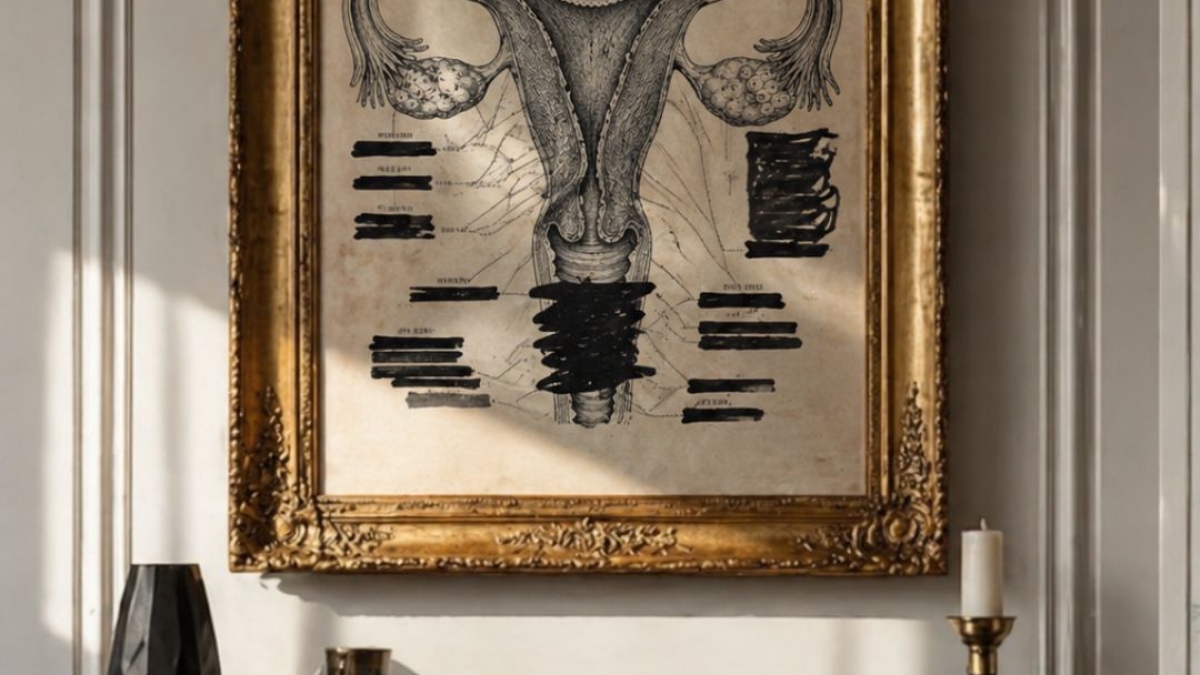
There are words that cause a stir. Not because they’re vulgar. Not because they’re insulting. Just because they refer to a female body part. Type “vulva” in an Instagram post, and you’ll see. Several content creators have learned this the hard way: visibility plummets, the account disappears from suggestions, and followers no longer see their posts. What platforms euphemistically call a “restriction,” those affected have named something else: the shadowban. Meta acknowledges this mechanism in passing, without ever specifying the rules. It primarily targets accounts focused on sex education, women’s health, and feminist activism.
The direct consequence: creators are learning to play word games. "Vµlve" instead of vulva. "Clitor!s" instead of clitoris. Absurd spelling contortions to fool an algorithm. An algorithm that, for its part, has no problem with misogynistic insults or content that demeans women, as long as it doesn’t show an anatomical diagram.
What Disappears, What Thrives
This is not a technical glitch. It is a symptom of a much broader imbalance.
In September 2025, the newspaper Les Nouvelles News documented the growing invisibility of feminist voices on digital platforms. Massive, coordinated reports, an expansive interpretation of European regulations on political advertising, algorithmic biases that penalize content deemed “sensitive”: feminist media outlets and accounts are paying the price. During the same period, Causette shut down, Giulia Foïs’s show disappeared from France Inter, and the magazine 50-50 announced the end of its operations. A media landscape that is shrinking on one side, while expanding on the other.
For while feminist voices are losing visibility, masculinism is gaining ground. In 2024, Irish researchers documented that it takes less than 26 minutes of passive browsing for TikTok and YouTube Shorts algorithms to steer a user toward masculinist content. Not because the user sought it out, but because the algorithms optimize engagement—and outrage drives engagement. According to the latest report from the High Council for Equality, young men who regularly use these platforms exhibit higher levels of hostile sexism. The “masculinist threat” is now the HCE’s top concern regarding equality in France. This is therefore not a problem of poorly managed content. It is a question of power: who speaks, who disappears, who decides what is visible.
The Masculine as a Universal Standard
To understand why the word “uterus” is upsetting, we need to look beyond algorithmic moderation. Behind the discomfort caused by female anatomical vocabulary lies a much older framework: the world has been conceived, designed, and measured using the male body as the universal standard. Everything else adapts to it as best it can.
This is not a metaphor. Car crash tests are a concrete example. For 75 years, the dummies used to test vehicle safety were modeled on a male body, not out of negligence, but by default. The reference body was that of men. That of women was a secondary variable. The consequences are quantifiable: according to data from the U.S. National Highway Traffic Safety Administration, women faced up to a 46% higher risk of injury in frontal collisions. It was a Swedish engineer, Astrid Linder, who created the first female-shaped crash test dummy, the SET 50F, in 2022. It is still not required by international regulations. The gap is gradually narrowing with new generations of vehicles; in 2022, the NHTSA noted a reduction to a 6% difference for cars from 2010–2020, but this improvement stems from generally safer designs, not from a deliberate decision to design for women.
When sports also go down the wrong path
The same pattern is found in the sports industry. A study published in 2025 in BMJ Open Sport & Exercise Medicine confirmed this scientifically. Female runners, for their part, have been experiencing this firsthand for a long time: buying “women’s” shoes usually means buying a men’s model that has been shrunk and repainted. The industry even has a name for this practice: “shrink it and pink it.” The more pronounced arch, the narrower heel, and the wider forefoot that characterize the female foot are nevertheless ignored in the design process. What is called the “women’s version” is often simply a variation of a product designed for someone else.
A sport designed by men, for men
Allyson Felix, the most decorated American athlete in track and field history, experienced this on a different scale. In 2017, when she became pregnant, her sponsor Nike decided to cut her earnings by 70%. The logic: a woman who gives birth performs less, so she earns less. In an op-ed published in The New York Times in 2019, she put it into words. Professional sports operate according to rules designed by men, for men, and there is no place for motherhood within them. She parted ways with Nike and created Saysh, her own brand of shoes designed for the female body. A few weeks after the launch, she became the most decorated athlete in the history of track and field, men and women combined. Nike finally revised its maternity policy. It took a woman fighting alone to get the rules to change.
Beyond sports, the examples are mounting. For decades, women were systematically excluded from clinical trials, deemed too “variable” due to their hormonal cycles, or too risky to include if of childbearing age. It wasn’t until 1993 that the U.S. FDA mandated their inclusion in new drug trials. The result of this long absence: women today suffer from side effects twice as often as men, and dosages remain, in most cases, identical for both sexes. Between 1997 and 2001, 8 of the 10 drugs withdrawn from the U.S. market were removed precisely because their adverse effects proved to be far more severe in women—effects that better representation in clinical trials could have anticipated.
When Silence Has Medical Consequences
This invisibility of the female body as a subject of study has very real consequences. Endometriosis is the most striking example. The disease affects approximately one in ten women of childbearing age in France, or between 1.5 and 2.5 million people. The average time to diagnosis is seven years. For seven years, women are told that their pain is normal, exaggerated, or psychosomatic. Three-quarters of affected women have been misdiagnosed with appendicitis, irritable bowel syndrome, or unexplained pain.
This delay is not solely due to a disease that is difficult to detect. It also stems from a medical system that, for a long time, conducted its research on male bodies and regarded women’s pain as a subjective, unreliable phenomenon. We don’t name the organs, we don’t teach about them, we don’t take them seriously. Thus, in a report published in 2016, the High Council for Equality noted that 84% of 13-year-old girls were unable to draw their own sexual anatomy, while more than half of them could do so for male anatomy. A quarter of 15-year-old girls were unaware that they had a clitoris. Since 2017, only one in eight biology textbooks has described it correctly. This is not an educational oversight. It is the exact reflection of an educational system that deems certain bodies worthy of being known, and others not.
Saturating the space, refusing to be erased
It is precisely in this context that an installation like Hystérie Collective takes on its full significance. Suspending hundreds of uteruses in an exhibition space, multiplying them until saturation, is a direct response to the logic of erasure. Where the algorithm shadowbans the word “vulva,” where feminist voices lose visibility while masculinist discourses thrive, where women’s bodies serve as adjustment variables in systems designed without them, the installation chooses the opposite excess: a massive, collective presence that cannot be ignored.
The pieces bear names that are diagnoses in themselves: The Angel Maker, The Scar, The Abused, The Mille-feuille of Troubles. Each suspended uterus names what society prefers to keep silent. Visitors must walk through them, around them, coexist with them. There is no possibility of looking away.
And sometimes, naming is enough to resist.