

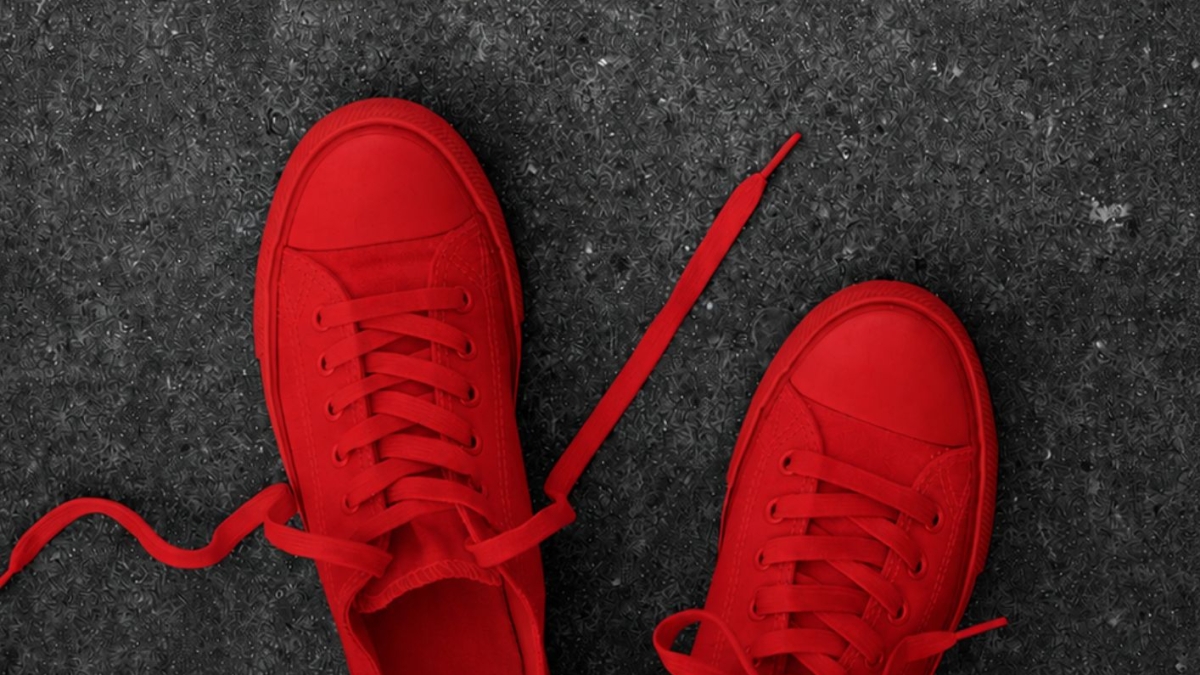
Some works of art don’t need to be explained. They speak for themselves. Dozens, sometimes hundreds of pairs of red shoes lined up in a public square, empty, silent. This is what Elina Chauvet created in 2009, in her hometown of Ciudad Juárez, Mexico. An installation that would cross borders, languages, and continents, and become one of the most powerful artistic gestures of contemporary feminism.
But to understand what these shoes mean, we must first talk about what they bear witness to. And what they have lost.
Ciudad Juárez, City of Femicide
On the border between Mexico and the United States, Ciudad Juárez became infamous in the 1990s for a seemingly endless wave of murders of women. Young women, often workers in the maquiladoras, the assembly plants that drive the border economy, would disappear, be found mutilated, or never return. Mexican authorities were slow to investigate, downplayed the situation, and sometimes even blamed the victims themselves. The term “femicide”, the murder of women simply because they are women, was partly coined in response to what was happening in Ciudad Juárez.
According to Amnesty International, more than 1,600 women’s bodies were found in Ciudad Juárez between 1993 and 2008, and more than 2,000 women are still missing.
Elina Chauvet is not an outside observer of this reality. Her own sister was murdered by her husband. She grew up in this context of normalized violence, in a region where women learn from a very young age to keep a low profile, not to walk home alone at night, and not to make too much of a presence. She is a visual artist, trained in the fine arts. And one day, she decided to transform her personal pain into a collective act.
The idea of the red shoes
The first Zapatos Rojos installation took place in 2009 in Ciudad Juárez. Elina Chauvet asked women in her circle, and soon strangers as well, to lend her their shoes. She painted them red. This red is not decorative: it is the color of blood, of urgency, of what cannot be ignored.
She arranged them in a line in the public square. High heels, ballet flats, sandals, sneakers. Children’s shoes, too. Each represents a woman who has been killed, gone missing, or abused. Absence is at the heart of the installation: there is no one in these shoes. That is precisely what breaks something in the viewer’s gaze.
For her, there is no question of creating a work in the traditional sense of the term, something you hang in a gallery and admire from a reasonable distance. She creates a protocol that others can adopt, reproduce, and adapt. She shares her idea. And the idea circulates.
An installation that belongs to everyone
Since 2009, Zapatos Rojos has been replicated in dozens of countries: Argentina, Spain, Italy, Turkey, France, and Canada. Each time, women, and sometimes men or even children, bring their shoes. Each time, the gesture takes on a local dimension: femicides in Guatemala, domestic violence in Europe, the disappearances of Indigenous women in Canada.
In France, feminist collectives and local organizations have organized installations in several cities. What is striking about these gatherings is their eerie silence. There are no shouted slogans, no marches, no speeches. Just shoes. And passersby who stop, count them, and finally realize.
That is where the political power of the work lies: it speaks to those who aren’t already convinced. Someone who knows nothing about feminism, who finds protests too loud or too “militant,” will still stop in front of rows of shoes painted red. He or she will ask the question. And asking the question is already a lot.
What art can do that the law cannot
It would be easy to reduce Elina Chauvet’s work to an aesthetic of mourning, beautiful, touching, and ultimately harmless. Zapatos Rojos has helped keep alive, in the public sphere, a conversation that institutions would rather silence.
In Mexico, femicides have not stopped. According to figures compiled by UN Women, the country records an average of 9 to 10 murders of women per day, a figure that does not include those who have gone missing. Justice remains slow, biased, and often absent. In this context, art is not a luxury or a consolation: it is sometimes the only way to name what the state refuses to count.
What Elina Chauvet does is also refuse to let these women be reduced to statistics. A shoe is personal. It belonged to someone. It has a shape, wear and tear, and above all, a story. The materiality of the object resists the abstraction of numbers. And that resistance is deeply political.
An artist in the tradition of everyday feminism
What sets Elina Chauvet apart from a certain kind of activist art that speaks mainly to those who are already there is her ability to work with what people have, their shoes, their bodies, their silent presence, to create something that transcends the framework of art.
She is part of a tradition of feminist artistic practices that turn the body and the intimate into a political terrain: one thinks of Suzanne Lacy and her participatory works on sexual violence in the 1970s, of Barbara Kruger and her slogans that colonize the visual space, of the Guerrilla Girls and their gorilla masks. But Elina Chauvet has something more immediate, more accessible. Her work requires no specific cultural context to be effective. It simply asks that we look.
Beyond the shoes, keep looking
What Elina Chauvet has understood is that visibility is a form of resistance. In societies where femicides are downplayed, where the disappearances of women don’t make the headlines, where the pain of families is treated as a news item, placing red shoes in the middle of a public square forces people to look.
And forcing people to look is, in itself, a refusal to forget.
Zapatos Rojos continues to spread. Collectives organize these installations regularly, including in France. If you want to participate in an upcoming installation or organize one yourself, the artwork is, by its very nature, accessible: simply paint some shoes red and place them somewhere where people pass by.
The Echo of the Antilles
Hysterie Collective brings together uteruses made from various materials fabric, cardboard, recycled materials, with each piece carrying a message about femininity, women’s rights, and current feminist issues.
In November 2025, the collection was expanded with La Piñata: a cardboard uterus covered in strips of colored paper, shaped exactly like the festive object that is struck until it bursts. Joy on the surface, vulnerability beneath. A tribute to Elina Chauvet and all the women killed in Mexico.