

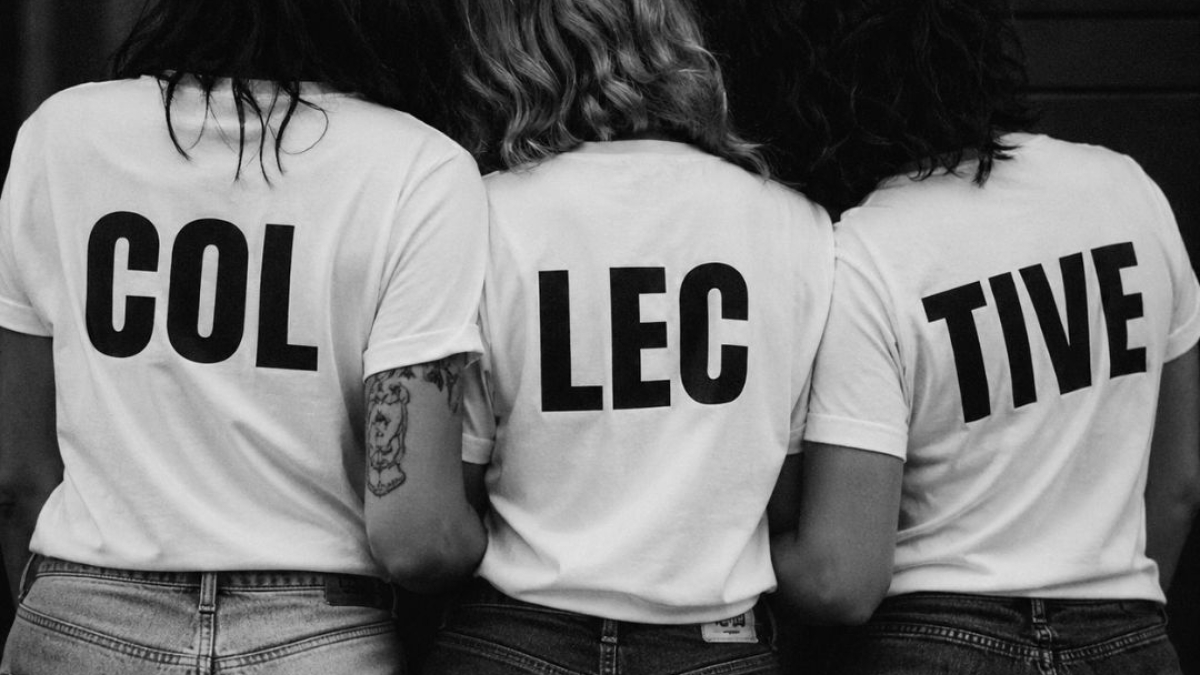
Some projects begin with an idea. Others, however, begin with a desire, the desire to create together, without yet knowing exactly what. That’s how Hystérie Collective began. Three women, three distinct artistic worlds, one certainty: to create something collaboratively. The subject, however, emerged almost naturally. When we look for what brings us together, what connects all three of us without exception, we quickly arrive at the same answer: being a woman. Not as a slogan. As a starting point.
Solen Cap, Marie-Lise Dabriou, and Nathalie Joris came together to create. And it is precisely this intention artistic, sensory, and collective, that gives the installation its unique texture. Something that is felt before it is analyzed.
Three worlds, a single space
What strikes you when you look closely at Hystérie Collective is the diversity of materials. Inner tubes. Padded fabric. Woven cardboard. Hangers, knitting needles, X-rays, etc. Some pieces are the work of a single artist; others were created collaboratively, through a shared technique or a collective vision. The whole holds together. It holds because the three artists worked to find common ground rather than impose their own directions.
Creating as a collective doesn’t mean erasing who you are. It means accepting that another’s vision broadens your own. Marie-Lise thinks in cycles: what is discarded, salvaged, transformed. Nathalie builds lightweight yet substantial cardboard structures. Solen, whose natural medium is fabric, holds the artistic and scenographic thread that ties everything together. Three ways of working, three sensibilities, a single purpose that takes shape at the intersection of it all.
What isn’t said often enough about collective creation is that compromises aren’t concessions. They are often the moments where the work becomes greater than what a single person could have imagined. A technical constraint becomes an idea. Hesitation over a material opens up an unexpected path. The collective, in this sense, is a method as much as a stance.
Making visible what is not visible
The choice of the uterus as the central form did not stem from a desire to shock. It stemmed from an obvious truth. This intimate and often silenced organ alone embodies a considerable amount of what women experience, endure, demand, or keep silent about. The right to control one’s own body. Motherhood
whether chosen or not. Pathologies ignored for too long. The way in which femininity itself has been defined, framed, and legislated by others.
By creating a multitude of them, dozens of suspended forms, the installation does not denounce. It shows. It occupies the space with this reality, gently but completely. Visitors do not look at a work hanging on a wall. They walk through it. They coexist with it. It is a physical experience before it is an intellectual one.
There is something profoundly right about this approach: not explaining, not commenting, letting the form speak for itself. An installation that fills the space with suspended uteruses does not need a three-page label. It establishes a presence. And that presence is enough to raise questions that each person takes with them as they leave.
A work that invites
Hysterie Collective is not a closed work. This is one of its most important characteristics, and perhaps the least visible at first glance. The installation is designed to grow, welcoming new pieces, new voices, and new materials contributed by other artists—women or men—who wish to contribute to the discourse.
This openness is not incidental. It says something essential about how the three creators conceive of their work: not as a territory to defend, but as a space to share. Femininity, women’s reality, rights that advance or retreat depending on the era and geography—none of this concerns only women. It concerns everyone. And an installation that addresses these issues has every reason to welcome diverse perspectives.
Men walk through the space of Hystérie Collective and emerge moved. Women recognize fragments of their own history there without anything being imposed on them. That is what art that works looks like: it creates the conditions for an encounter, not a lesson.
Alive, because the subject is too
What makes Hysterie Collective particularly apt in its form is that it is a traveling and evolving installation. It doesn’t look quite the same from one location to another, from one year to the next. It adapts to the space, incorporates new pieces, and draws inspiration from what’s happening in the world.
This is consistent with its subject matter. Women’s rights are not a fixed, unchanging achievement. In 2022, the U.S. Supreme Court overturned Roe v. Wade, removing federal protection for the right to abortion, a historic setback that served as a reminder that nothing is ever truly won. In France, the right to abortion was enshrined in the Constitution in 2024, a step forward that was both symbolic and concrete. All over the world, women’s realities are shifting, clashing, advancing in some places and regressing in others.
An installation that addresses all of this cannot be static. It must remain in motion, just as the bodies it represents are, just as the struggles it reflects are, without stirring them up. Hystérie Collective is a living work because femininity itself is alive, multifaceted, complex, and rife with contradictions and forces that art, better than any other language, knows how to hold together without reducing them.
Creating collectively, at its core, may also be this: choosing not to have the last word. Allowing the work to continue to take shape, to embrace, to grow. Allowing other women and other men to contribute their voices, their material, and their perspectives. Because the subject is too vast for a single pair of hands.