

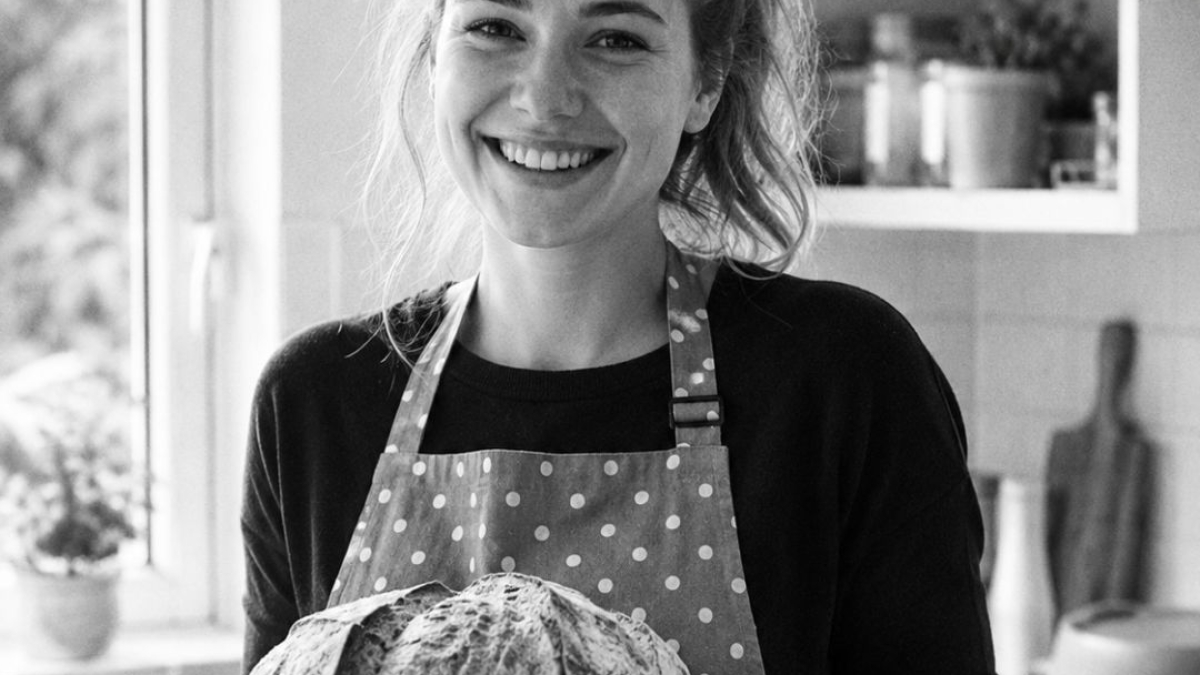
There’s a phrase making the rounds on social media right now, often used as a caption for a video of homemade bread or a woman showing off her Dutch oven as if it were a trophy: “I’m not a feminist, so I know how to cook.” It’s said with a smile or sometimes a wink. But this phrase deserves a closer look: being a feminist supposedly prevents you from cooking. From loving men. From wanting a life at home. As if feminism were an ideology against women, and not for them.
We might smile if this oversimplification didn’t have such serious consequences
The tradewife movement and its relationship to feminism
The term “tradewife,” or traditional wife, refers to women who choose to devote themselves to their homes. They publicly embrace this identity, often on TikTok or Instagram, with a soft, vintage, and very polished aesthetic. Linen aprons, jars of jam, children running in a garden. The content is often beautiful. And clearly, it attracts millions of followers.
What is striking is that this movement does not merely promote domestic life. It actively positions itself against feminism. The most influential content creators in this sphere do not say, “I have made my choice, and it is valid.” They say, “Feminism has lied to you.” Some influencers have amassed millions of subscribers on YouTube by explaining that women are naturally meant to serve their husbands. They add that feminism has made women unhappy and that equality is a dangerous illusion. In France, similar accounts echo the same arguments, with more discreet packaging but an identical core message.
So this is no longer just a lifestyle choice. It’s an ideology.
Being a feminist and loving to cook: a given that we should no longer have to defend
Feminism never said that a woman shouldn’t cook. It said she shouldn’t be forced to. That’s not the same thing.
Simone de Beauvoir cooked. bell hooks spoke of food and care as political practices. Generations of feminists have cooked, loved men, raised children, and managed households, all while fighting for these activities to be recognized, shared, and chosen. The problem has never been the apron, but rather the fact that we couldn’t take it off.
So when a woman says, “I’m not a feminist, so I know how to cook,” she’s caricaturing a movement in order to better reject it. And this caricature doesn’t come out of nowhere: algorithms that reward polarization construct and amplify it until it seems obvious.
Why this rejection of feminism is so appealing right now
We must try to understand, without endorsing it. These videos tap into something real: exhaustion. The double shift. The exhaustion of having to perform on all fronts at once. An IFOP survey published in 2024 clearly documents this: for two out of three working women, the daily mental load falls primarily on them, even when working full-time. In this context, the image of a serene woman in her kitchen, with no Zoom meetings to manage or reports to file, has a certain appeal.
Yet the solution the “tradewife” movement offers to this exhaustion is: give up on equality. Go back to a model where you have only one role. This isn’t a solution; it’s regression dressed up in pretty dishes.
What feminism offers instead is different: truly shared parental leave, domestic work finally recognized economically, a partner who actually does their share. It’s less photogenic. It takes longer to achieve, but it doesn’t require women to give up their rights to find peace.
The real problem with “I’m not a feminist”
When a woman says she isn’t a feminist, she often means she doesn’t identify with a certain image of feminism: the caricatured one of the angry woman burning her bras and hating men. This image is a construct. For decades, it has been used to discredit the movement. And it still works.
Yet in reality, most women who reject the word “feminism” support what it stands for: equal pay, the right to work, to vote, to divorce, and to be free from harassment. These rights exist because women fought to secure them. Calling yourself “not a feminist” while benefiting from these rights is a bit like using a road and refusing to acknowledge that someone built it.
And that is precisely where the “tradewife” trend becomes problematic beyond just a lifestyle choice. Because it doesn’t just say, “I love my life at home.” It says, “Feminism is the enemy of women.” It actively discourages young women from taking an interest in their rights, their economic autonomy, and the power structures that shape their lives. It presents dependence as wisdom, and subordination as femininity.
Being a stay-at-home mom and a feminist: not only is it possible, but it makes sense
A woman can choose to work from home, raise her children, cook every day, have a life centered on her home, and be a feminist. These two things are not mutually exclusive. What matters is that it is a genuine choice, made under conditions that allow her to change her mind, in a relationship where she is respected, with economic security that does not depend entirely on a partner’s goodwill.
Feminism does not judge the stay-at-home mom. It judges the structures that take away her options. It fights so that she can choose this role without risking losing everything in the event of a separation, without this work remaining invisible and unrecognized, without her having to beg for pocket money in her own home.
What the “tradewife” movement sells as freedom, returning to the traditional model, letting the man decide, not working, is precisely what feminism has fought against. Not because domestic life is inferior. But because when it is imposed, it traps women.
What these trends never mention
These accounts don’t mention the women who chose to stay home and found themselves with nothing after a divorce. The 2020 report by the High Council for Equality puts it bluntly: depriving a woman of her own income, keeping her out of the workforce, and seizing her earnings, these are mechanisms of control. Not mere details. Tools of control. Furthermore, these same accounts never mention that financial independence remains the primary protective factor for a woman in a relationship that goes south.
They show the bread coming out of the oven. Never what happens when the relationship falls apart and there is no updated resume, no retirement savings, no bank account of her own.
Feminism, on the other hand, looks at that part too. Because it thinks about women in the long term, not just when the light is beautiful and dinner smells good.